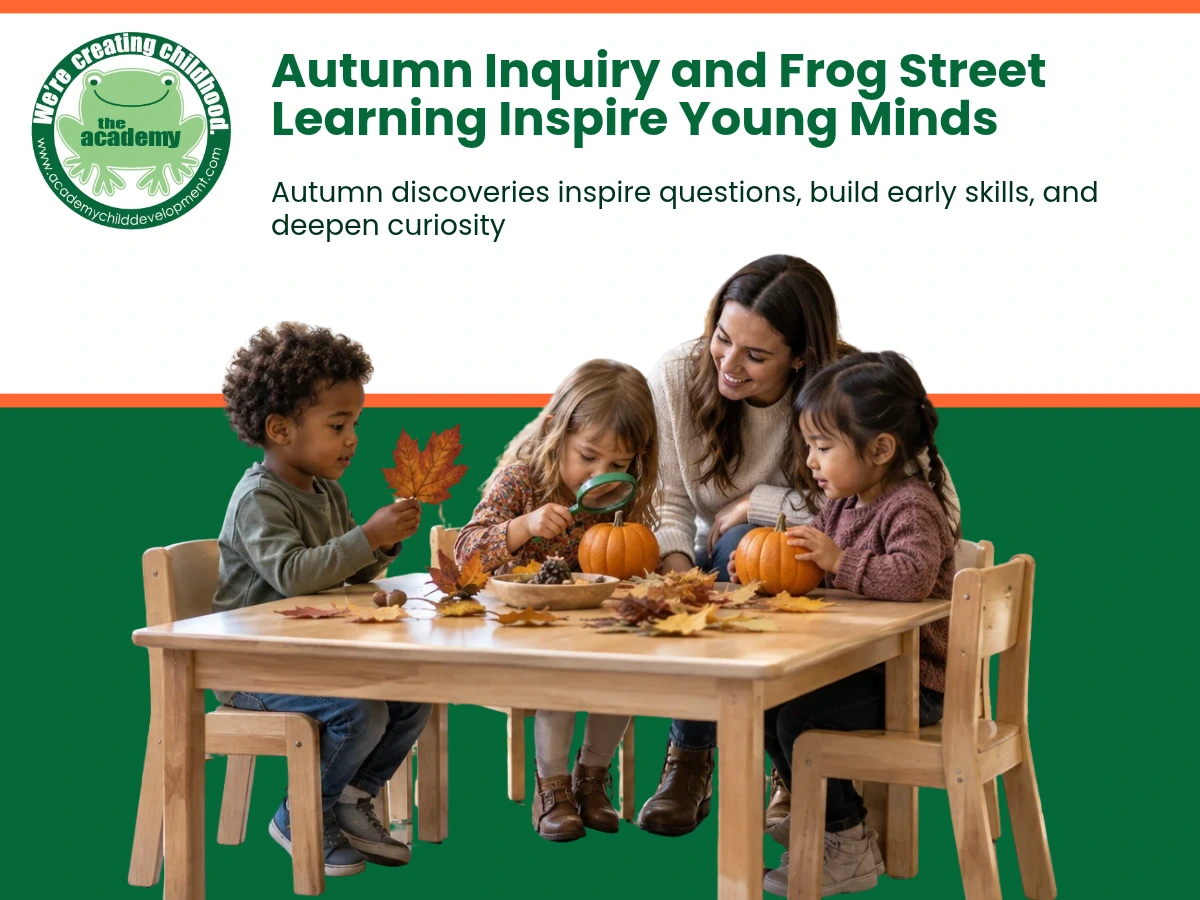
Choosing a preschool in Franklin, TN, involves understanding how everyday learning experiences prepare children for the years ahead. Counting objects, arranging shapes, and building structures give preschoolers meaningful opportunities to explore mathematical ideas. Through hands-on math and spatial play, children can investigate quantities, notice relationships, and test possible solutions.
These experiences also create opportunities to explain ideas and approach challenges with growing confidence. For Westhaven families, understanding the learning behind purposeful play offers a clearer picture of how early education can support the transition to kindergarten and the elementary school years that follow.
How The Academy of Westhaven Supports Purposeful Early Learning
The Academy of Westhaven, located at 114 Prospect Avenue in Franklin, describes a preschool experience built around consistent routines, engaging learning opportunities, and a warm classroom culture. Its approach emphasizes helping children feel known, encouraged, and comfortable participating in age-appropriate activities. These priorities provide a supportive setting for early exploration and discovery.
Connecting Curriculum With Active Participation
Across the Academy, the Frog Street curriculum combines purposeful learning with play-based discovery. Its Pre-K program identifies counting, patterns, sorting, and simple number concepts as areas of early mathematical learning. Children also have opportunities to observe, compare, and solve problems through hands-on activities.
A practical way to understand this approach is to consider the difference between hearing an explanation and investigating an idea. When children can move materials, make a prediction, and examine the result, they have something concrete to discuss. The experience gives meaning to the language adults introduce.
Giving Teachers a Thoughtful Guiding Role
Purposeful play benefits from adult involvement that extends a child’s thinking while allowing room for discovery. For example, an educator might invite a child to describe a plan before beginning or explain what changed after an attempt.
Useful prompts could include:
- Observation: “What do you notice about these materials?”
- Prediction: “What do you think will happen?”
- Reflection: “What could you try differently?”
These are examples of guided learning strategies, rather than a description of a specific Westhaven lesson.
Making Learning Visible to Families
For parents, a preschool visit offers an opportunity to explore how teachers guide children’s investigations. Asking how activities are adapted, how questions are encouraged, and how progress is shared can reveal the thinking behind the daily program.
This helps families understand how curriculum, teacher guidance, and participation work together throughout the preschool day.
Building Kindergarten Readiness in Franklin, TN, Through Learning Habits
Kindergarten readiness in Franklin, TN, includes the ability to participate in learning, communicate needs, and approach unfamiliar tasks with support. Hands-on investigations offer opportunities to practice these habits through purposeful activities. A child working toward a simple goal can experience planning, effort, and revision as connected parts of learning.
Following a Plan and Staying Engaged
A preschooler preparing materials for a project may need to remember what to collect, carry items to a workspace, and begin in an agreed sequence. These small steps create opportunities to practice following directions and keeping a goal in mind.
Adults can adjust the level of support. One child may benefit from a single instruction at a time, while another may be ready to follow two connected steps. The focus remains on meaningful participation at an appropriate level.
Explaining Ideas and Listening to Others
Practical activities give children something specific to communicate about. They might describe what they are making, explain a choice, or ask a classmate for an item.
In a shared task, children can practice:
- Expressing a plan: Describing what they intend to do.
- Requesting assistance: Identifying where help is needed.
- Considering another idea: Listening before deciding what to try.
- Reviewing an outcome: Explaining what worked and what remains unfinished.
The Academy’s Pre-K program includes communication, cooperation, independence, and classroom responsibility among its readiness priorities.
Responding Constructively to Difficulty
A task that requires another attempt allows an adult to model a manageable response. The teacher might help the child identify one change, try it, and observe the result.
Over time, families may notice a child asking for help more clearly or staying engaged longer. These observations offer useful insight into growing readiness, alongside developing academic knowledge. Progress should be considered within each child’s broader development and individual needs.
Developing Early Childhood Math Foundations Through Everyday Play
Early childhood math foundations include understanding quantities, recognizing relationships, and noticing how objects can be grouped or compared. Concrete materials allow children to investigate these ideas directly. Counting principles develop as children connect number words with objects and begin understanding that the final number counted describes the total in a group.
Connecting Counting With Quantity
Reciting numbers and counting objects involve related but distinct abilities. A child may know a number sequence while still learning to count each object once.
A simple activity might involve placing one large counter into each space on a tray. An adult can model touching or moving each counter once, then ask how many there are altogether.
Small groups of objects make it easier to observe the process. The adult can notice whether the child skips an item, counts something twice, or needs help connecting the final number with the whole collection.
Comparing, Sorting, and Recognizing Patterns
Playful math experiences can introduce different kinds of relationships:
- Comparing quantities: Match two small groups item by item to investigate whether they contain the same amount.
- Sorting by a feature: Group large objects by color, then reorganize them using another characteristic.
- Extending a pattern: Continue an alternating sequence using two types of classroom materials.
- Comparing measurements: Place two objects side by side to investigate which is longer.
These examples provide practical ways to explore ideas before introducing more abstract representations. NAEYC highlights sorting, size comparisons, and mathematical language as valuable elements of early math play.
Bringing Mathematical Thinking Into Home Routines
Families can extend this exploration through ordinary tasks. Setting out one napkin for each person or comparing two pieces of ribbon provides a clear reason to use mathematical thinking.
Brief, relevant questions allow children to explain what they notice. The emphasis remains on understanding relationships through experience, with time to revisit ideas as confidence develops.
Strengthening Spatial Thinking Through Construction and Shape Exploration
Spatial thinking involves understanding shapes, positions, and how objects relate to one another. Preschoolers explore these relationships when they rotate a puzzle piece, arrange materials to fit a space, or work out how to build a stable structure. NAEYC identifies shape exploration and spatial activities as meaningful parts of preschool mathematics.
Exploring How Shapes Fit Together
A puzzle provides a focused spatial challenge. A child must consider the piece’s outline, its orientation, and the space available.
An adult can draw attention to a relevant feature without completing the task. For example, noticing a curved edge may help the child compare the piece with the opening. Allowing time to rotate and reposition it preserves the opportunity to investigate.
Shape materials can also invite children to discover how smaller pieces combine to form a larger design.
Testing Ideas Through Construction
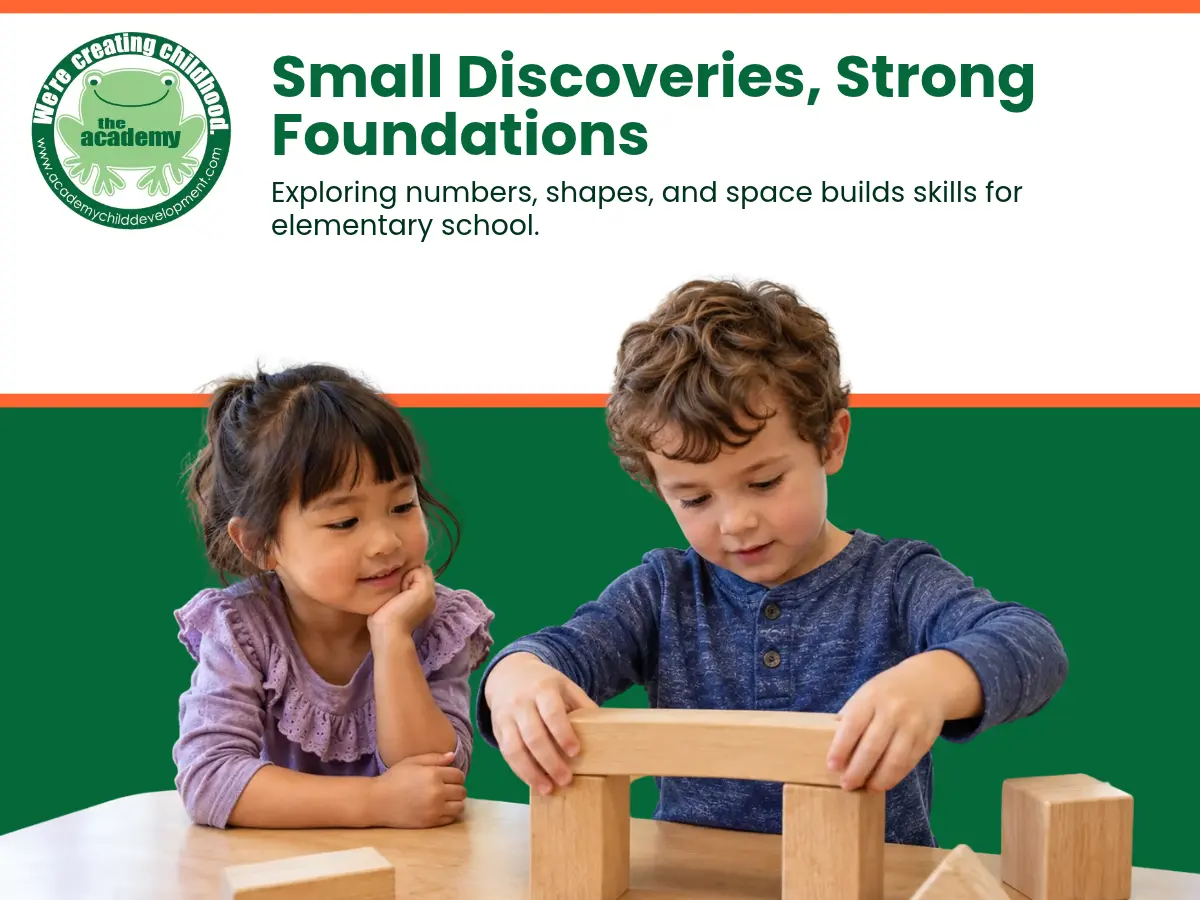
Building activities allow children to explore three-dimensional relationships. A proposed bridge needs supports, an opening, and a surface that spans the gap. Each adjustment changes the structure.
An educator might encourage children to:
- Identify what the structure needs to do.
- Choose materials for an initial attempt.
- Test whether the design works.
- Change one feature and try again.
The value lies in examining the relationship between a choice and its result. Block construction also provides opportunities to introduce spatial concepts such as above, under, and next to.
Using Position and Direction Language
Words such as “between,” “beside,” “inside,” and “behind” become clearer when connected to visible actions. When a child places a figure behind a building, they can see the relationship being described.
Families can use similar language while arranging toys or following a simple route outdoors. These experiences offer repeated opportunities to connect words with position, helping children describe spaces and understand directions with increasing precision.
Conclusion
The value of early math becomes visible when children use an idea with purpose: checking that everyone has a place setting, adjusting a structure, or explaining why a piece will fit. Hands-on exploration gives these discoveries a practical context while creating room for questions and further attempts.
For families choosing a preschool in Franklin, TN, observing how educators support this process can be especially helpful. Thoughtful guidance, age-appropriate challenges, and opportunities to investigate can help children approach future learning with greater understanding and confidence.
Discover the learning behind your child’s next step. Call The Academy of Westhaven at 615-805-6520 or visit https://www.academychilddevelopment.com/contact/ to arrange a tour.