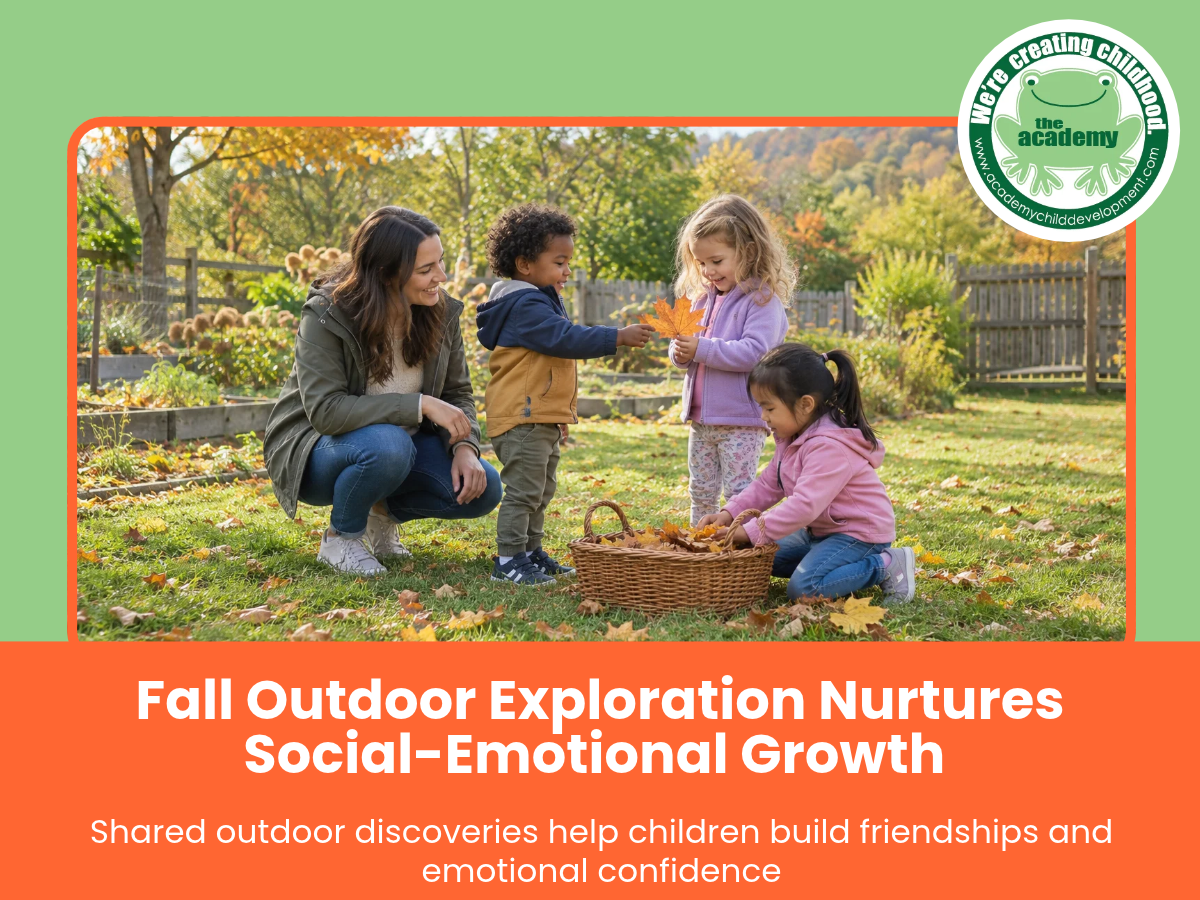
For families choosing a preschool in Bellevue, TN, outdoor exploration offers a meaningful setting for children to build confidence, friendships, and emotional awareness. Autumn brings shared discoveries that invite children to work together, from noticing changing leaves to planning a pretend harvest market.
Within these experiences, children practice expressing their needs, considering another person’s ideas, and managing small disappointments with adult support. The learning extends beyond the seasonal materials themselves. Thoughtfully guided outdoor play gives young children opportunities to develop social-emotional skills through experiences that feel relevant, engaging, and connected to the world around them.
How Fall Exploration Builds Friendships in West Nashville Daycare
A shared discovery can give children a natural reason to connect. When two preschoolers notice leaves gathering along a fence, they might begin collecting them, comparing their findings, or imagining a place to store them. Their interest creates an opportunity to communicate and develop a shared purpose.
In a West Nashville daycare setting, these everyday encounters can support early friendships when adults help children participate without directing every exchange.
Creating a Shared Purpose
Outdoor activities can invite cooperation without requiring a complicated project. Children might work together to arrange a pretend autumn picnic or create a temporary leaf display on the ground. Each child can contribute while practicing how to coordinate with someone else.
Teachers can support collaboration by helping children:
- Make a shared plan: Decide what they want to create and which materials they will use.
- Find meaningful roles: Offer different ways to participate, such as arranging materials or preparing a space.
- Exchange ideas: Listen when another child suggests a different approach.
- Recognize contributions: Notice how each person’s effort helped the group.
The goal is participation and connection, rather than a perfectly organized result.
Helping Children Enter Play
Joining an established activity can be difficult for a child who is still developing social confidence. An adult might help them observe what the group is doing, then suggest a relevant contribution.
For example, bringing an extra basket to a pretend harvest market provides a clear way to become involved. A teacher can model a simple request, such as asking whether the group needs help carrying materials.
Working Through Different Preferences
Shared play also brings disagreements. Two children may want the same role or have different plans for their display. With support, they can practice stating a preference, hearing another perspective, and choosing a workable next step.
These repeated experiences help children discover that friendships can accommodate different ideas.
Connecting The Academy of McCrory Lane’s Approach With Emotional Growth
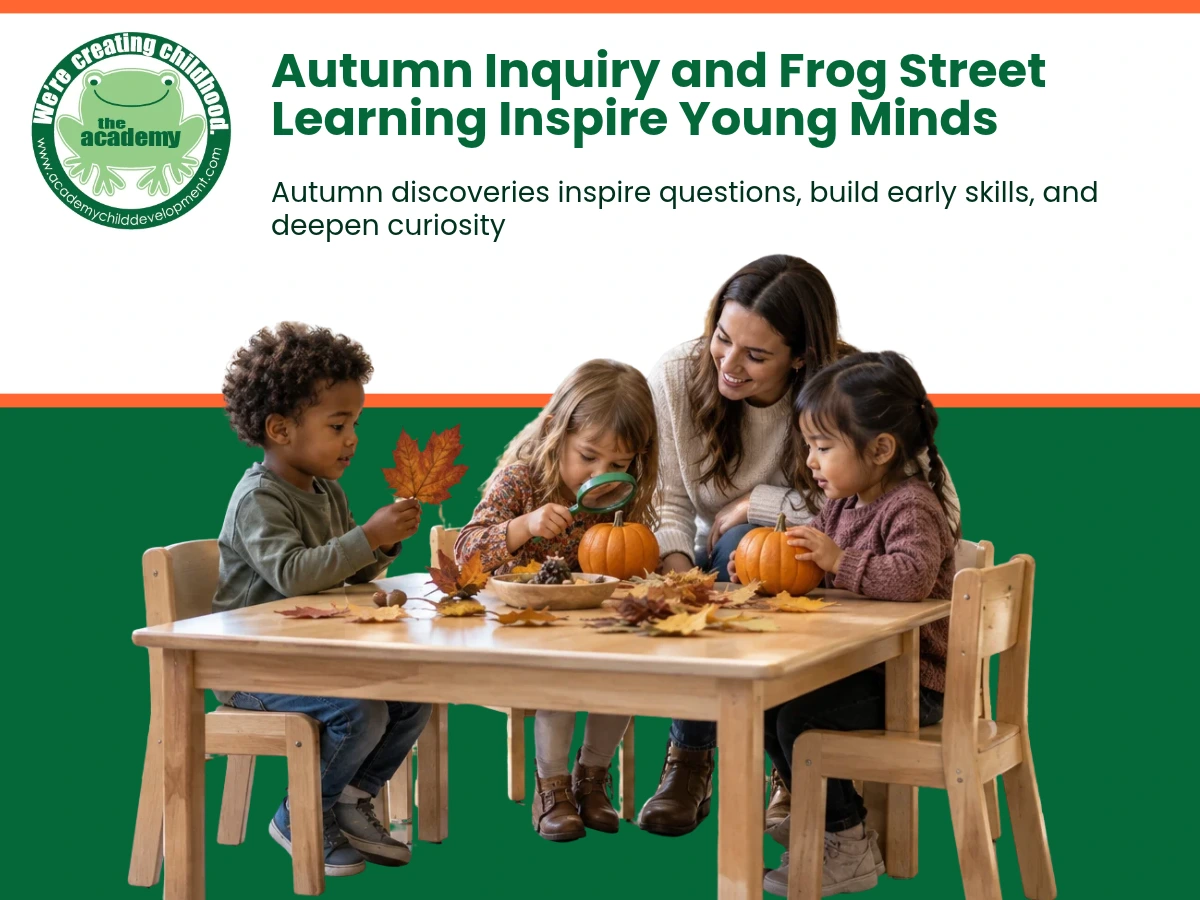
The Academy of McCrory Lane describes a nurturing environment built around consistent routines, encouragement, and early learning. Across The Academy, the Frog Street curriculum includes social-emotional learning alongside language and cognitive development. These priorities provide a useful framework for understanding how outdoor experiences can support emotional growth.
The examples below illustrate ways teachers can extend these principles into fall exploration, rather than describe a specific scheduled activity at the center.
Giving Feelings Clear, Familiar Names
Outdoor play brings a range of emotions. A child may feel proud after completing a task, uncertain about an unfamiliar texture, or disappointed when wind scatters a carefully arranged collection.
An attentive adult can acknowledge the experience before suggesting a solution. Naming disappointment helps a child connect a feeling with what happened. Recognizing hesitation communicates that taking time to observe is acceptable.
Children do not need to resolve every feeling immediately. They benefit from an adult who stays calm and available while helping them understand their response.
Offering Support Before Expecting Independence
Managing emotions develops through practice and responsive guidance. When a seasonal activity becomes frustrating, an adult can help a child:
- Pause: Step back from the task with support.
- Communicate: Use words, gestures, or another familiar way to express a need.
- Choose: Decide whether to try again, ask for help, or take a brief break.
- Return: Rejoin when ready, adjusting expectations if needed.
These options give children manageable ways to respond to difficulty.
Using Predictable Transitions
Ending outdoor play can be challenging when a child remains absorbed in an activity. A clear reminder, a familiar cleanup routine, and an opportunity to acknowledge unfinished work can make the transition easier.
Such support connects emotional learning with everyday routines. Over time, children gain experience recognizing their feelings and accepting help as they move between activities.
Building Confidence at an Early Learning Center in Nashville, TN
Confidence develops through opportunities to attempt manageable tasks, make choices, and recognize progress. For families evaluating an early learning center in Nashville, TN, fall outdoor exploration offers a useful example of how these opportunities can become part of an ordinary day.
A child who initially watches an activity may later participate alongside an adult, then attempt part of it independently. Each step has value, even when progress is gradual.
Providing Achievable Challenges
An appropriate challenge asks a child to stretch an existing skill without making success depend on adult rescue. Outdoors, this might involve carrying a partly filled basket, using a child-sized rake, or deciding how to move materials between two nearby spaces.
Adults can adjust the experience to the child:
- Change the amount: Reduce the materials being carried if the load feels difficult.
- Offer suitable tools: Choose equipment the child can hold and control comfortably.
- Break down the task: Practice one part before combining several steps.
- Allow another attempt: Give children time to adjust their approach.
These changes preserve the child’s active role while keeping the task manageable.
Recognizing Effort With Specific Feedback
Specific observations help children understand what they accomplished. Instead of offering only general praise, an adult might point out that a child used both hands to steady a basket or moved it when materials began falling.
This feedback highlights decisions and strategies the child can use again. It also helps make progress visible when the final result is modest.
Respecting Different Starting Points
Outdoor confidence doesn’t look the same for every child. Some readily approach new activities, while others need time, reassurance, or a quieter space.
Progress might mean choosing a tool, asking for help, or staying involved a little longer. Recognizing these individual steps supports participation without making comparison the measure of success.
How Families Can Reinforce Outdoor Social-Emotional Learning at Home
Family outings give children additional opportunities to use developing social-emotional skills with trusted adults. A short neighborhood walk or time in a familiar outdoor space can provide enough variety for meaningful practice.
The strongest connection to preschool learning often comes from how adults respond: allowing manageable choices, acknowledging feelings, and noticing considerate actions during ordinary moments together.
Share Decisions During Simple Outings
Invite your child to make a small choice within boundaries you have already established. They might select which familiar path to follow or choose where the family will pause to observe seasonal changes.
When siblings or friends are involved, adults can help everyone understand how to share decisions. One child might choose the first stopping place, while another selects the next.
The purpose is to give children experience expressing a preference while recognizing that other people also have ideas.
Notice Kindness as It Happens
Outdoor experiences offer opportunities to make caring behavior visible. A child may wait for someone walking more slowly, offer help with a dropped item, or make room for another person to see something interesting.
Describe the action and its effect. Noticing that a child moved aside so someone else could see helps connect their behavior with another person’s experience.
Avoid requiring a particular emotional response. Children can learn considerate actions while still developing their understanding of others’ feelings.
Reflect Without Turning the Experience Into a Test
After an outing, briefly revisit one meaningful moment. You might mention how your child asked for help or stayed involved when a plan changed.
Allow them to respond in their own way. Some children prefer conversation, while others communicate through drawing or pretend play.
Sharing a relevant observation with their teacher can strengthen the connection between home and school. Together, families and educators can recognize emerging skills and consistently encourage children as they practice them.
Conclusion
The milestones within fall exploration are often easy to overlook: a child invites someone into a game, asks for help before giving up, or finds a way to continue after disappointment. These moments reflect skills that children will revisit in friendships, classroom routines, and unfamiliar situations. With thoughtful guidance, outdoor experiences can make social-emotional learning practical in daily life.
For families seeking a preschool in Bellevue, TN, understanding how teachers support these moments can be an important part of choosing care.
Learn how The Academy of McCrory Lane supports your child’s next steps. Contact our team:
https://www.academychilddevelopment.com/contact/